

Definition: A digital twin (German: Digitaler Zwilling) is a digital copy of a real object, system or process that works as a virtual model.
This virtual copy lets you monitor, analyze and optimize the physical counterpart in real time. With sensor data and analysis tools, the digital twin can simulate and predict the behavior of the real system.
In recent years, the term "digital twin" has developed from a theoretical concept into a technology in practical use. NASA originally developed it for space travel. Today, the technology is widely used in Industry 4.0, IoT projects and smart manufacturing.
English: Digital Twin
Why Digital Twins Transform Industry
Digital twins play a central role in modern industry and technological development. They connect the physical and the digital world: they replicate real objects and systems in virtual environments and make them available for analysis.
This technology gives companies more possibilities in product development, in process optimization and in predicting the behavior of complex systems. Precise 3D models give a better data basis for decisions and more solid strategic planning.
Areas of Use: Where Digital Twins Are Used Today
Manufacturing industry: Manufacturers use digital twins to optimize production processes and make them more efficient. Digital copies make virtual simulations of production flows, live monitoring of machines and predictive maintenance strategies possible in the context of Industry 4.0.
Construction: In the construction industry, digital twins support project planning, construction monitoring and maintenance. As precise digital representations of buildings and infrastructure objects, they are an important addition to BIM (Building Information Modeling). Read more about 3D visualization in architecture.
Healthcare: Medical technology uses digital twins to generate patient-specific models. These virtual copies help doctors develop individual treatment concepts and make predictions about the course of therapy.
Key Benefits of Digital Twins
Real-time monitoring: Digital twins make continuous live monitoring of physical objects and systems possible. This lets companies react quickly to changes and improve process efficiency in the long term. Technologies such as IoT sensors supply the necessary data.
Cost savings: Early problem detection and preventive measures greatly reduce unplanned downtime and repair costs. Digital twins make system states transparent and prevent expensive failures with predictive analytics.
Better product development: In the development phase, digital twins speed up the innovation process. Design engineers and developers can test and optimize different scenarios virtually, without expensive physical prototypes. CAD data is the basis for this.
AI and Machine Learning: The Intelligent Core
Artificial intelligence (AI) and machine learning (ML) are the technological backbone of modern digital twins. These technologies let digital twins learn from historical and current data and predict behavior.
AI-based digital twins identify complex relationships and patterns that manual analysis can hardly find. Algorithms detect deviations from normal behavior automatically and can take preventive action before faults occur.
Machine learning also lets the digital models improve continuously. The continuous analysis of real-time data refines the prediction models, and their recommendations become more and more precise. Read more about big data and data analysis in an industrial context.
Leading Software Platforms and Tools
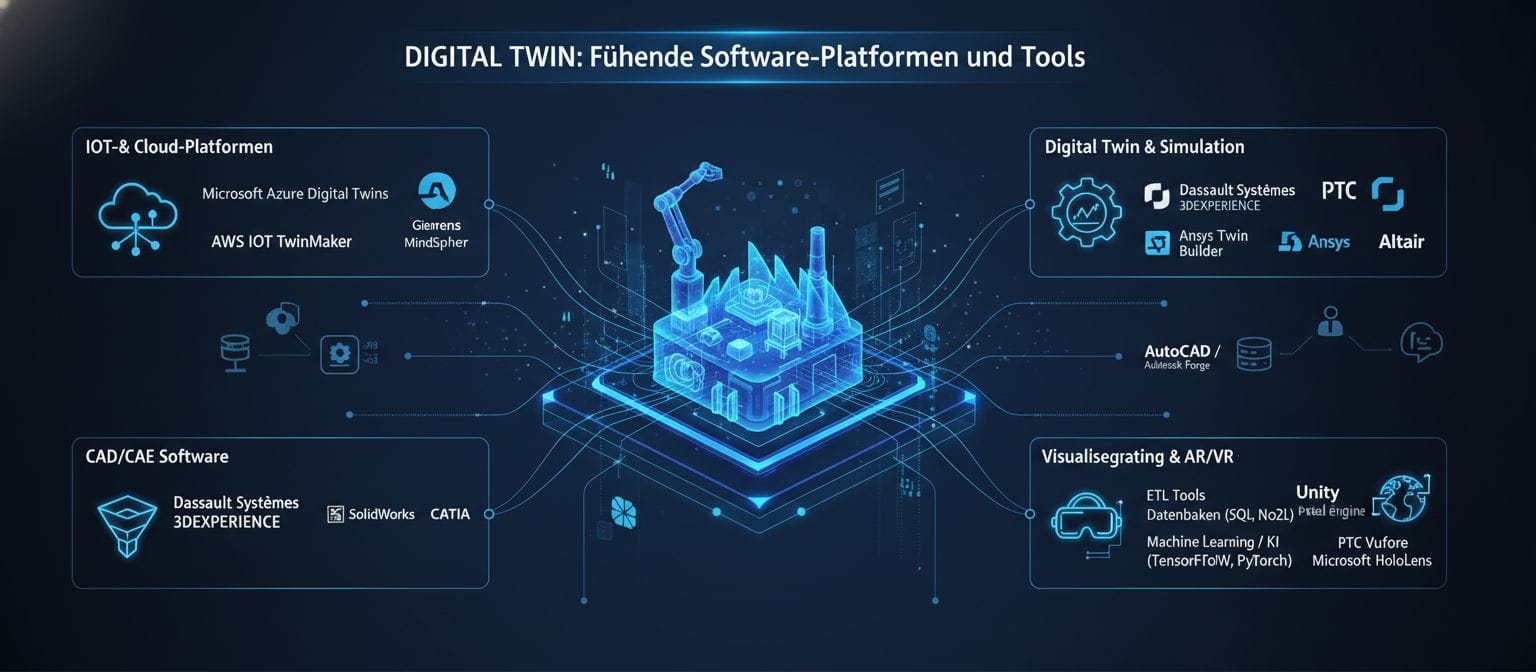
Siemens MindSphere: This open IoT platform collects, analyzes and processes machine data from production environments in real time. MindSphere is the basis for industrial digital twin applications. [More about MindSphere]
IBM Watson IoT: The IoT platform from IBM combines AI and machine learning to generate digital twins. It gives real-time analyses and predictions about the states of physical systems. [Watson IoT documentation]
PTC ThingWorx: As an IoT platform, ThingWorx gives you comprehensive tools for digital twin management. The solution is widely used in manufacturing, construction and other industries. Integration with AR applications is possible.
ANSYS Twin Builder: This specialized software focuses on the modeling and simulation of complex physical systems. ANSYS Twin Builder is especially suitable for engineering applications and real-time rendering.
Dassault Systèmes 3DEXPERIENCE: This integrated platform combines modeling, simulation and analysis tools for digital twins in one continuous development environment. It is especially strong in the 3D pipeline.
Microsoft Azure Digital Twins: This cloud service lets developers create comprehensive digital representations of physical environments. Azure Digital Twins integrates seamlessly into the Microsoft cloud infrastructure. [Azure Digital Twins]
Oracle Digital Twin: As part of the Oracle IoT Cloud, this platform gives you tools for digital twin management. It supports IoT data analysis and business process optimization across industries.
Bentley Systems iTwin: This infrastructure management platform uses digital twins to monitor the full building lifecycle, from planning to operation. It is closely linked with BIM workflows.
Summary: The Future Is Digital

Across industries, digital twins become a key technology of the digital transformation. They give precise virtual copies of physical objects and systems. This creates new possibilities for process optimization, cost reduction and innovative product development.
The combination of 3D visualization, IoT sensors and AI-based analysis makes completely new approaches possible in product development, manufacturing and maintenance. Companies that use digital twins strategically get a lasting competitive advantage.
Frequently Asked Questions (FAQ)
How are digital twins different from conventional 3D models?
The difference is the data connection. A classic 3D model is a static visual display without live data. A digital twin continuously integrates sensor data. This makes real-time monitoring and dynamic simulation of the physical counterpart possible. Read more about the difference between 3D visualization and digital twins.
What role does artificial intelligence (AI) play in digital twins?
In digital twins, AI systems analyze data patterns, create prediction models and support automated decision processes. Machine learning lets the model adapt continuously to changing conditions.
Which security aspects must you consider when you use digital twins?
Data security is the top priority in digital twin implementations. Companies must implement encrypted data transfer, role-based access control and regular security updates to protect sensitive information from unauthorized access. This is especially critical for cloud-based solutions.
What are the hardware requirements for digital twins?
The requirements depend on the complexity. Simple twins run on standard hardware. Complex simulations need powerful servers or cloud infrastructure. WebGL-based solutions also make browser-based display possible without special hardware.
Relevant Standards
ISO 23247 – Digital Twin Framework for Manufacturing: This international standard defines a reference framework for digital twin implementations in the manufacturing industry. [ISO 23247]
ISO/IEC 30141 – Internet of Things (IoT) Reference Architecture: This standard specifies a reference architecture for IoT systems, which are the technological basis for digital twins. It sets structural and functional requirements for IoT architectures. [ISO/IEC 30141:2018]
OPC Unified Architecture (OPC UA): This cross-platform standard defines protocols for secure and reliable data exchange in industrial automation environments. [Unified Architecture]
ISO/TS 18101 – Industrial Automation Systems and Integration: This technical specification contains guidelines for the integration of industrial automation systems, a key requirement for operating digital twins. [ISO/TS 18101-1:2019]
Digital Twin Consortium Standards: This cross-industry organization develops standards, guidelines and best practices for the implementation and use of digital twins. [Digital Twin Consortium]
Associations and Organizations (DACH)
- VDMA (Verband Deutscher Maschinen- und Anlagenbau, the German mechanical engineering industry association) [Web]
- Plattform Industrie 4.0 [Web]
- Bitkom (Bundesverband Informationswirtschaft, Telekommunikation und neue Medien e.V., the German digital industry association) [Web]
- Plattform Industrie 4.0 Austria [Web]
- Industrie 2025 (Switzerland) [Web]
Market Development and Statistics
Market growth in Europe: According to forecasts, the European digital twin market grows at a compound annual growth rate (CAGR) of 38.1% until 2030. Industry 4.0 technologies, big data analytics, IoT connectivity and AI applications drive this development. [Source]
Market volume: Analysts forecast a volume of USD 12.4 billion for the European digital twin market by 2030. [Source]
Adoption in mechanical engineering: According to the VDMA, more than 40% of German mechanical engineering companies already use digital twins or plan to introduce them. The highest growth rates are in plant engineering and automation technology.
Related Topics
Technological basics: - 3D model – The geometric basis of digital twins - 3D visualization – Display of virtual copies - Real-time rendering – Real-time display of complex models - WebGL – Browser-based 3D graphics - 3D pipeline – Workflow from CAD to 3D
Related technologies: - IoT (Internet of Things) – Connection of physical objects - Industry 4.0 – Digitalization of production - CAD (computer-aided design) – Design data as the starting point - BIM (Building Information Modeling) – Digital twins in construction - Predictive analytics – Forward-looking data analysis
AI and data processing: - Artificial intelligence – Intelligent data analysis - Machine learning – Systems that learn - Big data – Processing of large amounts of data - Cloud computing – Infrastructure for digital twins
Visualization technologies: - Augmented reality (AR) – Overlay of virtual content - Virtual reality (VR) – Immersive 3D environments - Mixed reality (MR) – Combination of real and virtual worlds


